The Reality
Rome wasn’t built in a day, and Cheese Bank won’t be either.
If you are coming from The Spreadsheets, hopefully you have a full understanding of Cheese Bank and its endgame.
$9 billion is the goal, but not where we will start. Below is the more grounded reality of the origin of Cheese Bank.
How would we begin?
Most likely it would be small, incremental drops into a bowl the size of the ocean.
Let’s Start At The Origin
Finding a penny on the ground was like finding a little piece of gold.
Robert “Opa” Miller, 2026
If you walked past a penny on the ground would you pick it up? I don’t have any statistics on that question, but I think I know the answer: You would not.
In a recent chat with my grandpa, or Opa as he is called, he explained what it was like to scavenge dirty, grimy pennies from the street in 1949. A couple pennies could buy you a donut, with only ten being enough for an entire large bag of potato chips from the factory across the street. Today you would need 150 pennies for a donut or 429 pennies for a large bag of chips.
Perhaps our collective decision will change on picking up pennies, given they are no longer produced by the U.S. mint, however the sentiment will remain unchanged: One cent is an insignificant amount of money in today’s day-and-age, not worth bending over and touching the ground for.
Could this meaningless value be the key to paying for all childhood cancer treatment forever?
Let’s break it down: within the United States, 15,780 children between birth and 19-years-old are diagnosed with cancer each year [1]. Families then pay $35,000 out-of-pocket over the course of the treatment of their child [2]. So, childhood cancer diagnoses add an estimated $552,300,000 per year in out-of-pocket financial burden to American families.
Problem solved! We just need a penny-a-day from 340,000,000 Americans and no family will pay for their child’s cancer treatment again!
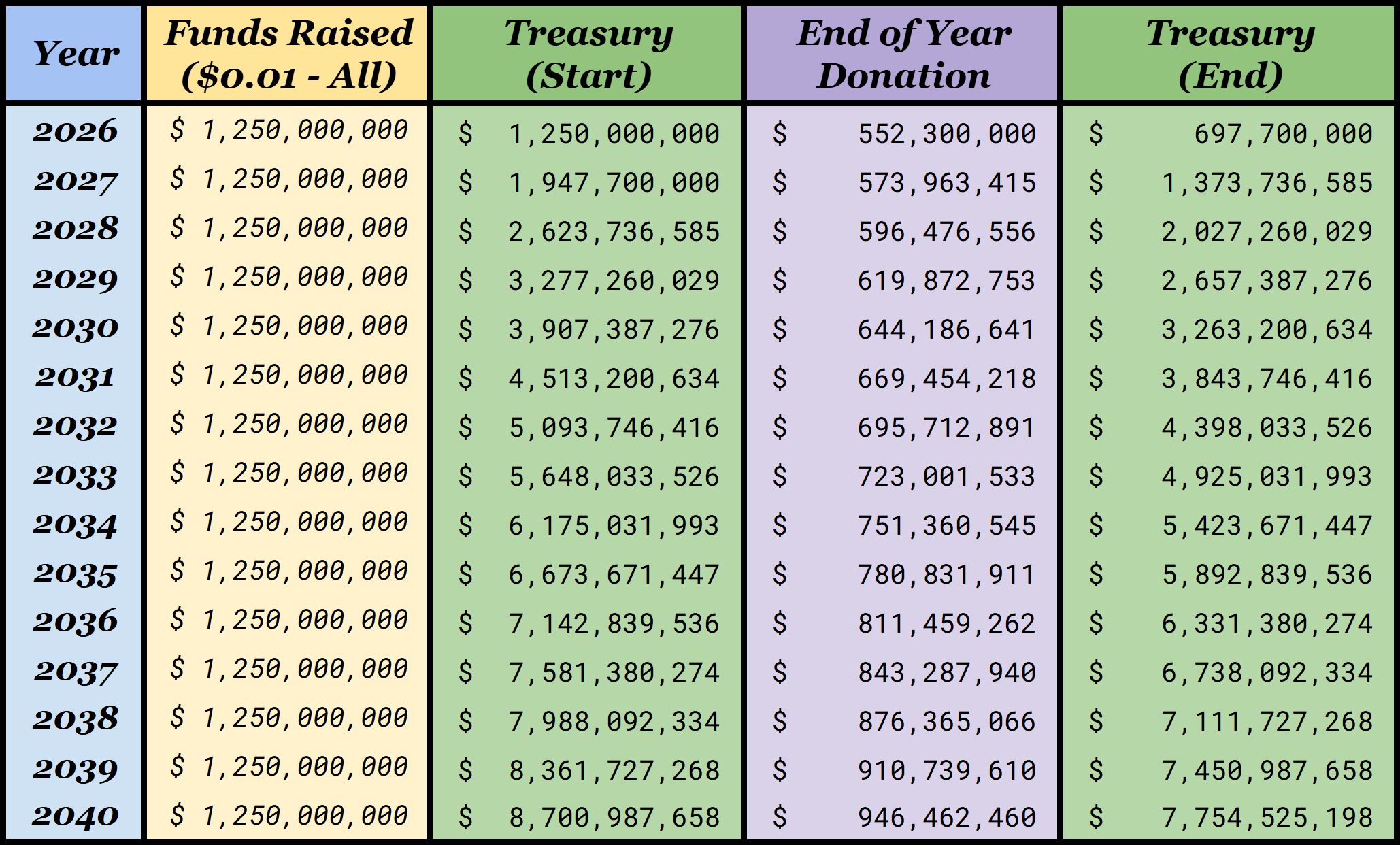
Firstly, that is to assume that all Americans would be willing and able to contribute. While I did conduct a survey with a college professor of mine, concluding 97% of about 150 psychology students at UNC Chapel Hill would be willing, that is likely not the whole truth.
Albeit, collecting the cent-per-day would be a logistical nightmare, even more challenging would be getting individuals to follow through with their proclaimed willingness.
For the sake of the thought experiment, let’s say that all working Americans (170 million) are willing and able to give $0.01 per day. How’s it look now?
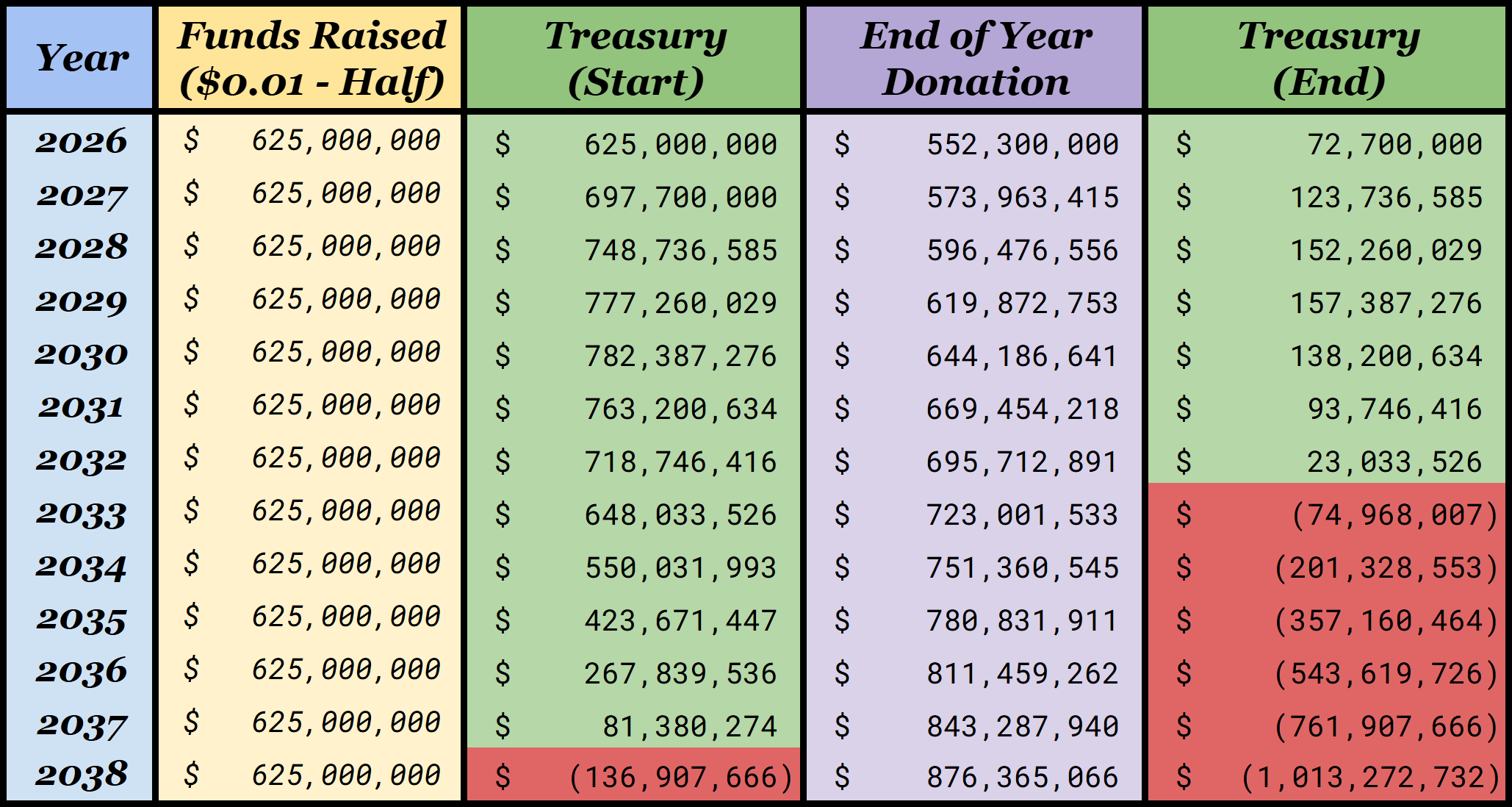
Not very good. As you can see from the conditional formatting that turns scary numbers red, we are now operating in the negative. We encountered the true enemy of this idea: inflation. The second most evil word, just behind taxes. By the 8th year of operation, our $625 million per year no longer matches the adjusted cost of treatment due to annual inflation. By 2039, the excess we saved from previous years has now run dry.
Even with the full force of all Americans raising an astounding $1.25 billion per year in the first example, the treasury would run dry around 2070 by my crude estimations.
Is our idea dead in the water?
A-Cent-A-Day Endowment
The aim of Cheese Bank is to collect $0.01-a-day (all at once as $3.65 due to logistics) to establish an endowment to pay for all childhood cancer treatment. To reach our goal of $9 billion that would take:
2,465,753,424 years worth of pennies
2.47 billion people in one year
or 246 million people over 10 years
or 123 million people over 20 years
Alas, I fear we are getting a little UNREALISTIC.
Is it still worth trying?
Let’s pretend 15,000 people see this idea and truly believe in it, all pledging to contribute $3.65-per-year, for 20 years. How’s it looking now? (Tip: See The Spreadsheets: Example - $1.00 / Example - $2.00 for a formatting explanation).
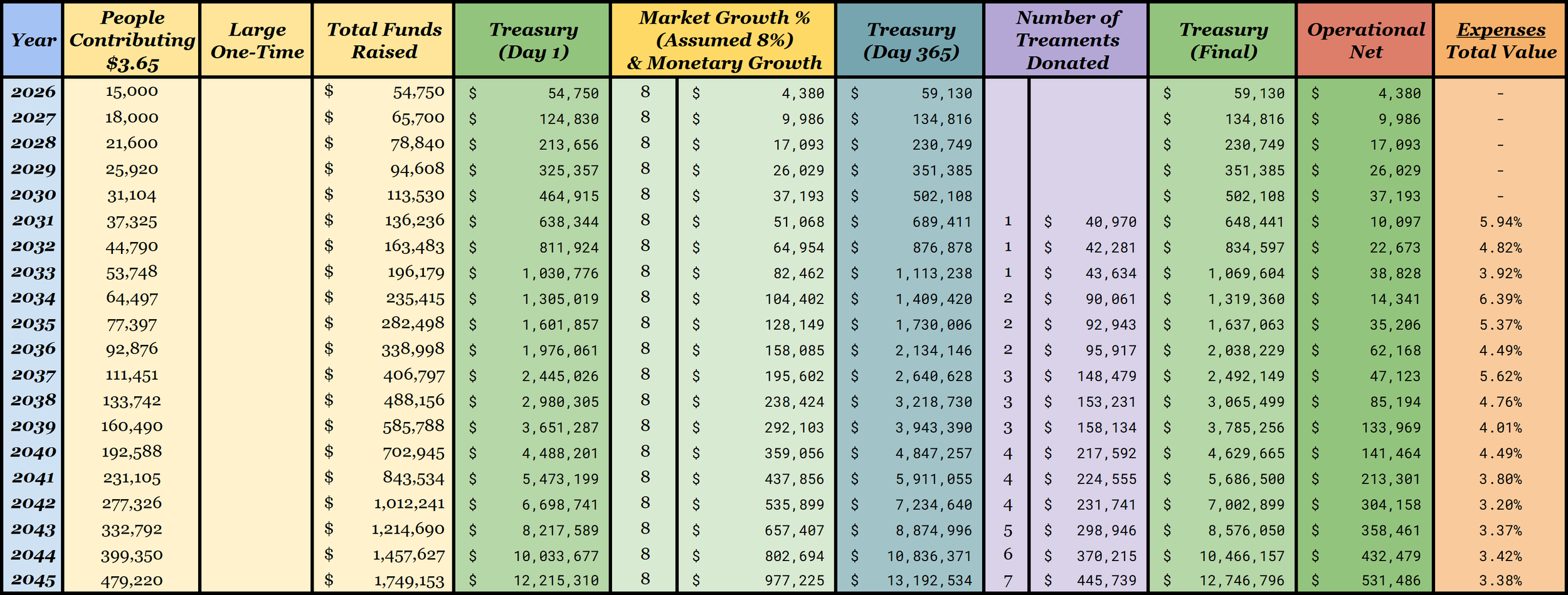
We will propose a hypothetical 20% growth in People Contributing $3.65, correlating with the same increase in Total Funds Raised each year. We have set our Market Growth to a more conservative 8% annually. We still skip a few years of donations (as explained in The Spreadsheets), not only factoring in stock market volatility, but as well as years to cement our internal processes.
These include: establishing the endowment itself, working with a small but dedicated team, and connecting with hospitals or foundations (as discussed in The Execution). In addition, this time allows for Cheese Bank to become more well known in the public sphere.
By the 5th year, we hope to start supporting families, even if in a small way. By the 20th year, our Number of Treatments Donated is growing and our impact is widening.
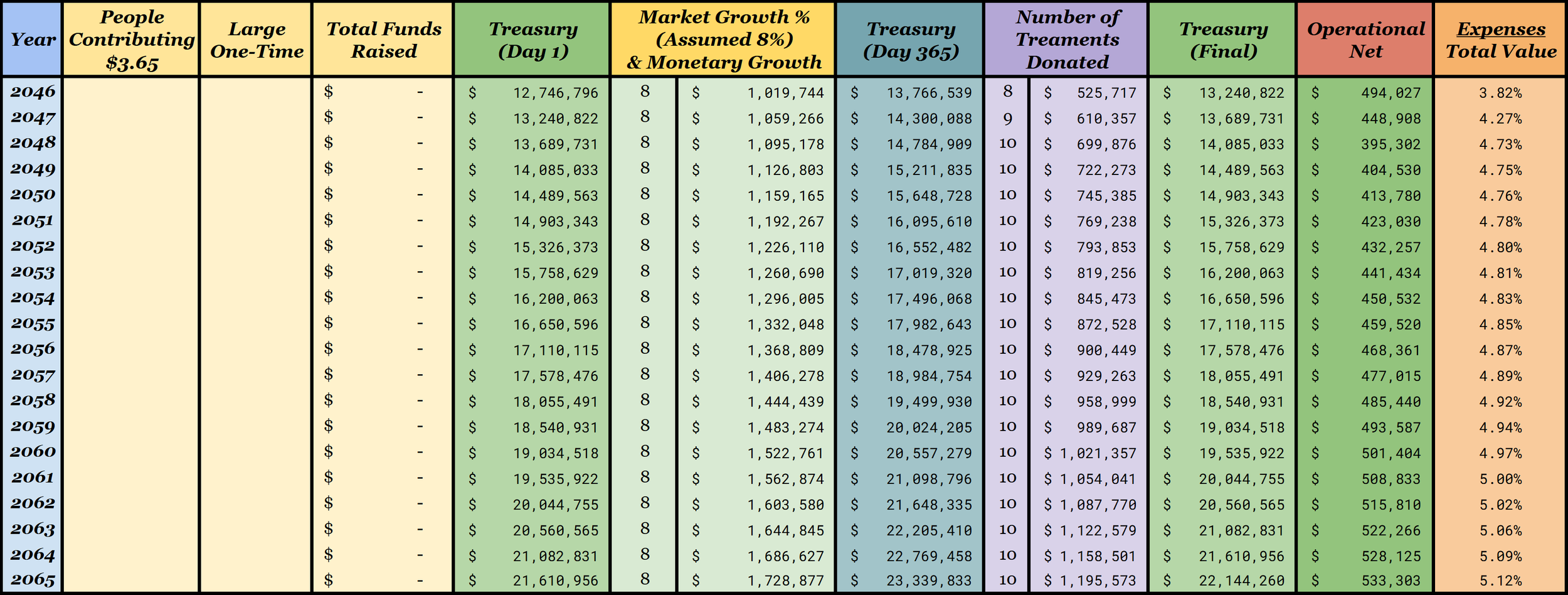
In the continuation of the previous sheet, Cheese Bank hypothetically closes its doors to contributions of $0.01-per-day. Even doing so, we can still sustain an annual donation of 10 cancer treatments… forever. That is, as long as we keep the equation Expense/Total Value at approximately 5% (the typical ratio in real endowments).
The Conclusion
A-Cent-A-Day is a feasible concept that can have a significant impact. So let’s just do it!
Check out the final chapter of Cheese Bank below: